




Smokejumping involves parachuting into remote areas to suppress wildfires, with the goal of reaching and containing fires before they have a chance to grow. For Team Injinji Athlete Paul Ganelin, a career in wildland firefighting had always been on the horizon. After five years as a Hotshot, an opportunity at the Missoula smokejumper base opened the door to a new challenge, taking his work into some of the most remote and rugged terrain.
We caught up with Paul to learn what his work looks like as a smokejumper, how he stays busy outside of work and the role foot health plays in his demanding job.

Introduce yourself! Born and raised?
My name is Paul Ganelin III, and I was born and raised in Chula Vista, California, just south of San Diego. Chula Vista is often underestimated for its beauty, with rolling hills and trails overlooking Baja and the Pacific Ocean. Within an hour, you can be in the mountains of Mount Laguna and Cuyamaca, which rise above 6,000 feet and even receive snow in the winter.
Can you tell us about your background in wildfire fighting and smokejumping? What drew you to this type of work?
I started my firefighting career at the age of 16 through the San Diego Fire-Rescue Department’s cadet program. It gave me an early appreciation for work ethic, integrity and what it takes to become a well-rounded firefighter.
After high school, I attended a fire science program, earned my EMT certification and volunteered whenever I could. I eventually attended a wildland fire academy and applied for wildland firefighting jobs through USAJOBS. I started on a Type 2 hand crew, where we used hand tools to create firebreaks by removing vegetation down to bare mineral soil. I knew I wanted to become a Hotshot, so I worked hard to earn that opportunity. [Note to readers: a Hotshot is a highly-skilled Type 1 wildland fire crew member that responds to the most complex and dangerous wildfires.]
After a couple fire seasons, I joined Laguna Hotshots, a crew I had looked up to for years. My cousin had also spent several seasons on the crew, which made it even more meaningful.
Being a Hotshot was an honor. We worked 24-hour shifts on the fireline, sometimes running chainsaws day and night, sleeping in the dirt for 14 days and then heading back out across the country after just two days off. The 20 people on a crew become family, and those relationships last a lifetime.
After five years as a Hotshot, I was looking for another challenge. Smokejumping had always intrigued me, even though I had never actually seen a smokejumper. I loved the idea of working in remote wilderness, getting to fires while they were still small and doing a job that didn’t need much recognition. I contacted seven smokejumper bases across the country, and the Missoula base pointed me in the right direction. Eventually, I received a call offering me a rookie candidate position.

What is a smokejumper? How is it different from firefighting?
Smokejumpers are wildland firefighters who parachute into remote areas to fight fires, usually when they’re still small and can be contained before they grow.
The idea of parachuting firefighters into wilderness areas was considered pretty crazy when it was first introduced, but it had a purpose: get personnel to fires that would otherwise be difficult to reach quickly. Smokejumping has been used since July 12, 1940, and it remains an important tool in wildland fire suppression.
Smokejumpers are still firefighters at their core. They use hand tools and chainsaws, make decisions under pressure and work to contain and extinguish fires. The parachute is simply how we get to the fire.

For readers who aren’t familiar, what does a typical day on an assignment look like? Give us a crash course.
There really isn’t a typical day as a smokejumper. You can get a fire call, hear the siren and have just two minutes to get your jump gear on. You might be headed to Washington, Alaska or somewhere else entirely. My first fire jump was actually in British Columbia, Canada.
Once we arrive, we jump into remote terrain and work to contain the fire before it grows. Sometimes the landing zone is nowhere near the fire, and there’s no trail to get there. We might spend hours bushwhacking through steep terrain, climbing thousands of feet and working through dead and downed trees.
Once the fire is contained and completely out, we pack up everything we brought in, including the tools and supplies dropped from the plane and carry it all back out. That can mean several days of hard work in the wilderness.
What does training to be a smokejumper look like?
Smokejumper rookie training lasts about six to eight weeks and is extremely demanding. It involves long days in the woods, strenuous physical work and learning to operate under fatigue.
After the initial training, rookies must demonstrate what they’ve learned and complete approximately 20 to 30 successful parachute jumps without error. The standards are high, and not everyone finishes the program. Even after rookie training, you aren’t officially a smokejumper until you’ve completed your first fire jump.
This year was my first time helping with rookie training as the lead physical training instructor. It was a privilege to take on that responsibility and help prepare the next generation of smokejumpers. I’ve coached CrossFit, running and personal training during the winters, so being able to bring that background into the program and give back was really rewarding.

Why do we need smokejumpers?
Smokejumpers help get experienced firefighters to remote fires quickly, especially fires started by lightning that are difficult to reach by road or trail. The goal is to catch fires while they’re still small and prevent them from growing into much larger incidents. Having a crew that can parachute directly into wilderness areas gives us an important advantage when time and access are limited.
Is it scary to parachute out of a plane into remote wilderness?
Jumping has never really been the scariest part for me. The most intense moments are usually flying around looking for the fire and figuring out the logistics of getting out of the plane safely. Once I’m in the air, everything slows down. It’s quiet except for the sound of the parachute, and you get an incredible view of land you’ve never seen before.
We jump in groups called sticks, usually two to four jumpers, and rely on each other to fly safely and predictably into technical terrain. Flying a good pattern and making a safe landing are always on my mind. After we land, we call in our cargo, which includes hand tools, saws, water, satellite phones, bear spray and the supplies we need to spend several days on the fire.

What gear are you typically carrying?
After a fire is contained, we pack up all our gear, including the extra tools, saws and supplies dropped from the plane. Everything gets divided among the jumpers, and the loads can reach 120 to 140 pounds.
Every jumper takes pride in being strong enough to carry their share, whether they’re a rookie or have been jumping for 10 years. Rookie training tests that strength, and we still want to prove we can pull our weight on every fire.
The long pack-outs are actually my safe place. I find peace in carrying a heavy pack through the wilderness. The more physically demanding part for me is often running a chainsaw or digging handline through the night. Being on your feet for hours on uneven ground, sweating in your boots, can really take a toll on your feet.
Is there a particularly physically demanding day you’ve experienced on the job?
One fire stands out because I wasn’t able to take my boots off for a couple of days. The temperatures were high, and my feet got wrecked. I was dealing with what I believe was trench foot, and it got to the point where I thought I might need to go to the hospital.
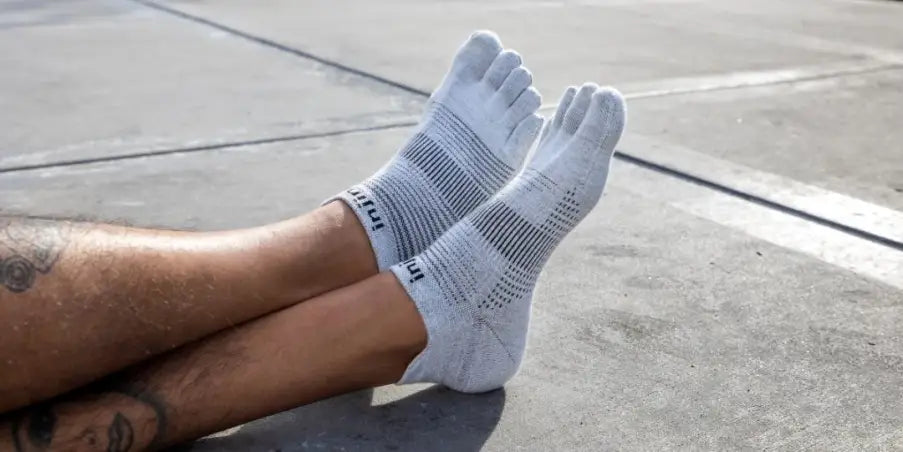
I had always worn Injinji socks for running, but I never thought much about wearing them in my fire boots. The separation between my toes helped keep them from staying wet and irritated, and they finally started healing.
What is the biggest misconception people have about smokejumpers?
The comment I hear the most is that we jump out of helicopters and that is false. We have only jumped out of planes. Helicopters would move a bit too slow. Another misconception is that we free fall for a long period after exiting the plane and that is also false. We have a specific five-second count because we jump at an elevation that most skydivers consider loco at 3000 feet above the ground. Decisions are precise, and no mistakes can be made. That is a huge reason training is as difficult as it is.
Which Injinji toesocks are best for wildlife firefighters? Which ones do you wear and why?
The comment I hear the most is that we jump out of helicopters and that is false. We have only jumped out of planes. Helicopters would move a bit too slow. Another misconception is that we free fall for a long period after exiting the plane and that is also false. We have a specific five-second count because we jump at an elevation that most skydivers consider loco at 3000 feet above the ground. Decisions are precise, and no mistakes can be made. That is a huge reason training is as difficult as it is.
Why is foot health important for smokejumpers?
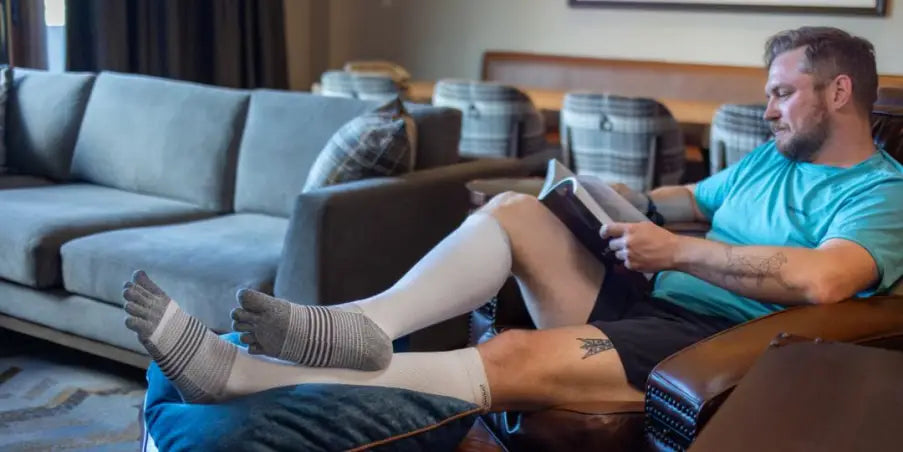
If your feet aren’t in good shape, working a fire quickly stops being fun. You’re spending long hours on uneven terrain, often in hot boots and sometimes you can’t take them off for hours or even days.
We have a saying on the fireline: “Fresh sock day.” Everyone knows how good that feeling is and how important it is to keep your feet healthy.
After experiencing how badly my feet could get damaged on a fire, I realized how much the right socks matter. Keeping my toes separated and managing moisture made a huge difference in my comfort and recovery.
Outside of smokejumping, what athletic pursuits or projects are you currently working on?
Trail running, splitboarding, climbing, mountaineering and biking are where my real love for fitness is. The gym has always been a tool to help me excel outside.
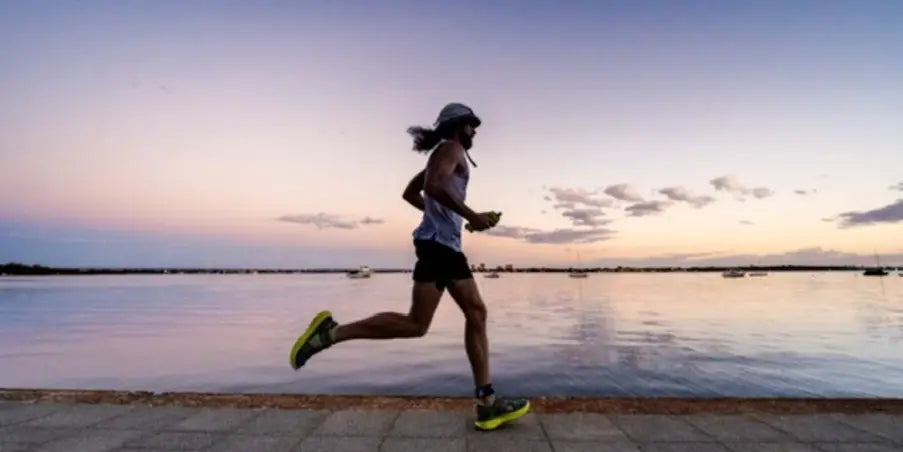
I love competition, but my schedule doesn’t always allow me to train for something specific. Running is the simplest way to stay active during fire season, and I try to squeeze in miles whenever I can.
This year, I’m working toward 1,000 hours of overtime and 1,000 miles of running. We’re getting close to both goals as fire season winds down.
My next big race is the Mount Laguna Trail Marathon, which will be my seventh year running it. It’s always an accomplishment to finish, especially after a fire season when training has been limited. I’m also looking forward to the Dalton 50K, hosted for the first time by Dalton Hotshots. Beyond that, I’d love to try a HYROX competition and go under 60 minutes in the pro division, or compete in some local CrossFit events.

How’s your husky doing?
I’ll be spending the next few months with Mikko, my husky and best friend. He’s been part of my entire career in fire and has taught me so much about being smart outdoors.
We’ve spent the last 12 years running thousands of miles, climbing mountains and snowboarding in the backcountry together. Last year, he tore his ACL while snowboarding with me, and he started slowing down a little after that. Eventually, he was diagnosed with an autoimmune disease, and the doctors told us it might be best to let him rest.
I wasn’t ready to hear that, especially as the fire season was getting busy. But I could see in his eyes that he wasn’t okay, and I also knew it wasn’t his time. My partner and I did everything we could to help him recover, and it started working. He was gaining muscle and getting up on his own again.
Then, about a month ago, I got the call that he’d torn his other ACL. Mikko has always been nonstop, so I wasn’t surprised. We decided to go through with another surgery, and now, five weeks after the operation, he’s slowly cruising the trails, making friends and howling like he’s still a puppy.
Life is a little slower on the trail with Mikko now, and that’s okay. He’s the one who taught me how to go fast. Now he’s teaching me how to be patient. We’ll take as many miles as we can get, fast or slow. Miles are miles with Mikko.

Where can people follow along with your journey?
I stay most active on Strava and Instagram: paulganelin
I hope you all enjoy your day and your public land, Paul Ganelin.