


Runners, hikers, walkers and everyday adventurers: this one’s for you. Your feet are your foundation, and a strong, healthy body starts from the ground up. As you train for your next race or personal goal, foot strength might not be top of mind, but it should be. Neglecting it can lead to injury, while building it can unlock your best performance yet.
In this blog, meet Allison Wiedman—Doctor of Physical Therapy, Team Injinji Athlete, two-time All-American runner, track coach and mom of three. She doesn’t just talk about foot strength, she lives it. Beyond her collegiate accolades, Allison has earned two top-ten age-group finishes at the Ironman World Championship in Kona. Now in her 40s, she continues to set personal bests while also bringing her experience as both an athlete and a Doctor of Physical Therapy to the community.
Read on to discover her expert insights on how to recognize the signs of weak feet and unlock practical tips to help you train smarter, move better and stay injury-free.

Allison, can you tell us how you got into physical therapy and how that world merges with your athletic career?
I discovered physical therapy during college while competing as a Division I athlete in cross country and track, where I naturally gravitated toward the medical side of performance. Shadowing physical therapists, I was immediately drawn to the problem-solving nature of the profession; every patient presents a unique puzzle, and the goal is always to restore efficiency and optimize movement. As a lifelong athlete, I've always viewed the body as a dynamic, interconnected system, and that perspective shapes how I approach both training and rehabilitation. My athletic background and clinical work are deeply intertwined: I understand firsthand the demands of training, the mental side of competition, and the frustration of injury, which allows me to connect with patients on a different level and build treatment plans focused not just on getting out of pain, but on returning to sport stronger and more resilient.

Why is foot health important? Why is it important to have strong feet?
Your feet are the foundation of all movements, supporting a complex system of muscles, tendons, and joints. They absorb shock on landing and act as a stable lever to propel you forward, while also playing a key role in balance and stability. When the feet are weak or dysfunctional, the effects ripple upward, often contributing to issues at the ankle, knee, hip, and even the lower back. Strong, healthy feet allow your entire body to move more efficiently, perform at a higher level, and help reduce the risk of injury up the chain.
What Are 5 Signs Your Feet Are Weak?
1. Arch collapse or flat feet when standing or walking
The arch of the foot is designed to support and distribute load efficiently across the entire foot. When the arch collapses, that load is no longer managed well, leading to less efficient force transfer and increased stress on surrounding structures. Over time, this can contribute to plantar fasciitis, posterior tibial tendon issues, and altered mechanics further up the chain.
2. Excessive pronation during gait
Some degree of pronation is normal and necessary for shock absorption, but too much can be a sign that the foot lacks the strength to control motion through the gait cycle. When the foot rolls inward excessively, it creates a chain reaction that can affect the ankle, knee, and hip alignment, increasing the risk of overuse injuries.
3. Frequent foot fatigue or soreness with activity
If your feet feel tired or sore after relatively normal amounts of walking, running, or standing, it is often a sign that the small stabilizing muscles in the foot are not strong enough to handle repeated load. Healthy, strong feet should be able to sustain activity without breaking down quickly. Persistent fatigue is the foot's way of signaling that it needs more support and strength.
4. Poor balance or instability, especially on one leg
Balance is not just a neurological skill, it is heavily dependent on the strength and responsiveness of the intrinsic muscles in the foot. These small muscles are constantly making micro-adjustments to keep you stable. When they are weak, single-leg tasks like balancing, running, or changing direction feel unstable and require more effort from the rest of the body to compensate.
5. Toes gripping or clawing during activity
When the deeper stabilizing muscles of the foot are not doing their job, the toes will often grip or claw at the ground in an attempt to create stability. This compensation might go unnoticed at first, but over time it can lead to toe deformities, increased tension in the plantar fascia, and general inefficiency in how the foot functions during movement.

What expert tips do you have for those looking to improve their foot strength? How do you get foot pain relief?
1. Activate and strengthen your feet
Start with simple exercises that wake up the small muscles. Toe scrunches, where you actively scrunch your toes toward your heel to create a short, domed arch, help activate the intrinsic muscles that support the foot from within. Big toe raises, where you press your big toe into the ground while lifting the smaller toes, or lift the big toe independently while keeping the others down, build the isolated control needed for efficient push-off during walking and running. From there, progress to single-leg balance movements like single-leg stands on a folded towel or single-leg Romanian deadlifts to build stability, coordination, and proprioception from the ground up. As those become more manageable, integrating the foot into full-body movements like split squats, step-ups, and single-leg jumps with a controlled landing will reinforce how the foot functions as part of the entire system during real athletic demand.
2. Give your feet room to move
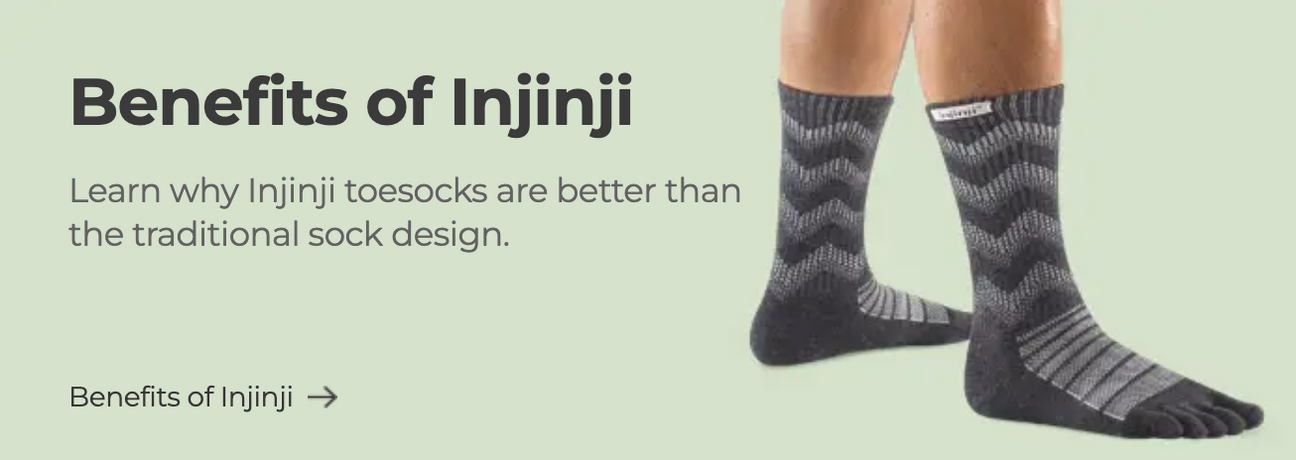
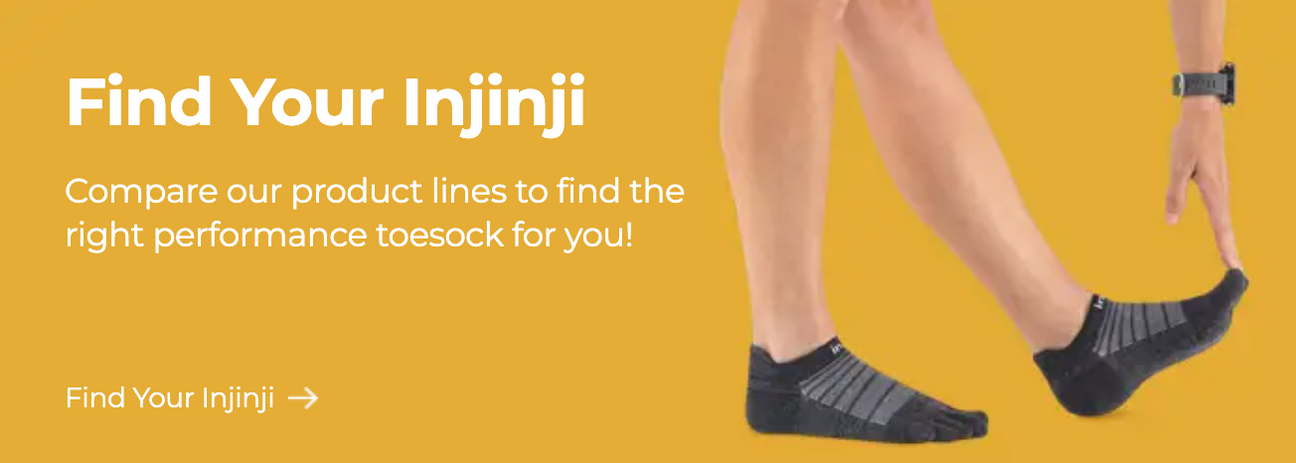
Constrictive shoes and socks limit natural foot movement and reduce sensory input over time. Try walking around barefoot when at home or swap your regular socks for toesocks like Injinji that allow each toe to move independently. Small changes in how you treat your feet daily can add up significantly over time.
3. Prioritize foot and ankle mobility
Strength without mobility only gets you so far. Roll the bottom of your foot on a small ball, mobilize the arch over a half foam roller, and move the foot and ankle through controlled ranges of motion regularly. This helps restore joint mobility, improve sensory input, and reduce stiffness that builds up from daily activity and prolonged time in shoes.
4. Think beyond the foot
Strength without mobility only gets you so far. Roll the bottom of your foot on a small ball, mobilize the arch over a half foam roller, and move the foot and ankle through controlled ranges of motion regularly. This helps restore joint mobility, improve sensory input, and reduce stiffness that builds up from daily activity and prolonged time in shoes.

Outside of your recommendations above, what gear do you recommend people wear to help and why is it helpful?
-
Wide toe box shoes: Shoes with a wide toe box (like Altra or Topo Athletic sneakers) allow the toes to splay naturally during movement. This improves balance, stability, and force production through the foot, and reduces the compression that contributes to issues like bunions, hammer toes, and plantar fasciitis.
-
Minimal or barefoot style footwear: Minimal and foot-shaped shoes encourage more natural movement by reducing the amount of cushion and structure the shoe provides. Over time, this challenges the intrinsic foot muscles to do more work, which can build strength and improve proprioception.
-
Toesocks: Toesocks like Injinji separate each toe individually, reducing friction and encouraging proper toe alignment during activity. They work particularly well paired with a wide toe box shoe, giving each toe the space to function independently.
-
Toe spacers: Toe spacers gently encourage natural toe positioning and help restore spacing that is often lost from years of wearing narrow or constrictive footwear. Regular use can improve muscle activation, enhance balance, and reduce tension across the forefoot.
Want to learn more about the benefits of toe separators? Read more here.